VPN Affiliate Programs for Streamers: 2026 Rates
StreamerPerks earns a commission from some outbound links. How programs are checked and how the site is funded.
VPN Affiliate Programs for Streamers: 2026 Rates and Rules
The best-documented VPN affiliate programs in October 2026 are NordVPN and Proton VPN. Both publish 100% on new 1-month sales, 40% on 1- and 2-year plans and 30% on renewals. Surfshark publishes a flat 40% with a 30-day cookie, and ExpressVPN pays a one-time CPA that it does not publish. For streamers, how you disclose a VPN promo on Twitch and YouTube matters as much as the rate.
> As of October 2026. Every rate below was read on the brand's own affiliate page on October 7, 2026. Where a brand does not publish a number, the table says so instead of borrowing a figure from a third-party directory.
What changed since the 2025 edition?
The 2025 version of this guide covered three brands and used approximate figures like "~40-60%". This edition covers six programs and drops the approximations. Three things on the official pages are worth knowing before you apply anywhere.
ExpressVPN says plainly in its affiliate FAQ that it does not pay recurring commissions: "we work on a CPA basis with all of our affiliates." The CPA itself is set in an insertion order after approval, so nobody outside the program can quote it honestly.
Proton now publishes a full rate table on its affiliates page, and its VPN rates match NordVPN's line for line.
Surfshark's affiliate page lists a flat "40% revenue share" and says custom payouts are possible for strong performers. The 40-60% range from last year's edition is not on the page, so it is gone from this guide.
Which VPN affiliate program pays the most in 2026?
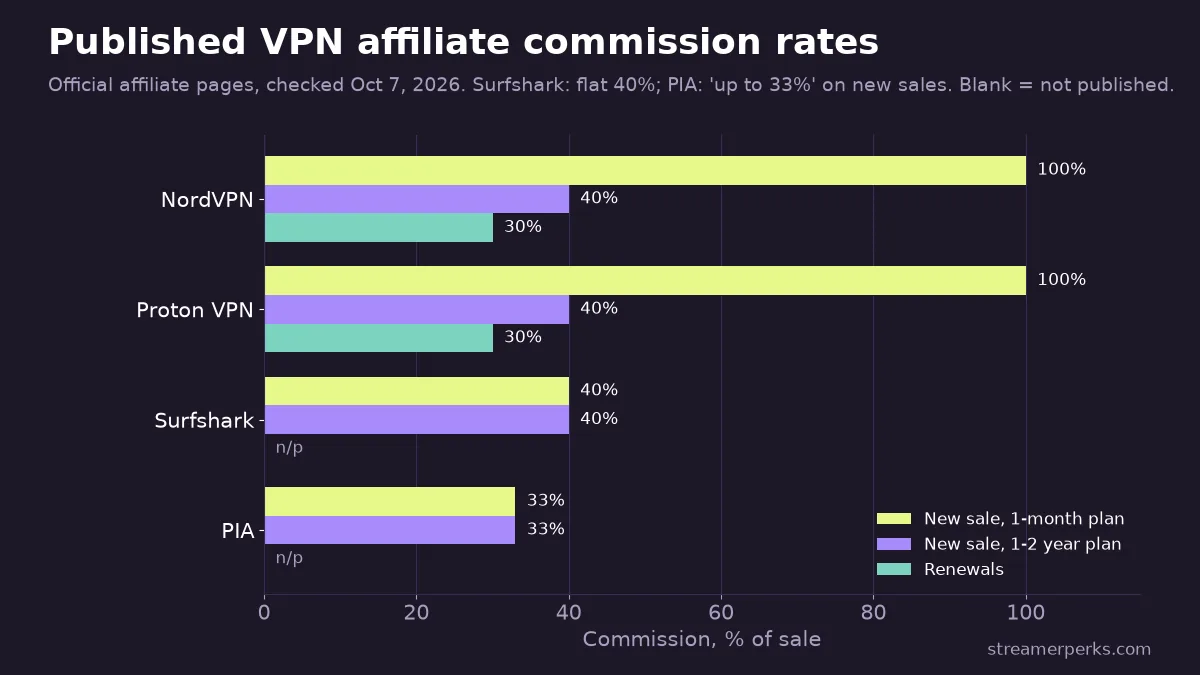
On paper, NordVPN and Proton VPN tie. The 100% figure only applies to 1-month plans, though, and most VPN buyers pick a 1- or 2-year deal because the monthly price drops so much. Expect most of your referrals to earn the 40% rate, plus 30% each time the customer renews.
| Program | New sale | Renewals | Cookie | Platform | Min. payout |
|---|---|---|---|---|---|
| NordVPN | 100% (1-month), 40% (1- and 2-year) | 30% | 30 days | Own program | Not published |
| Proton VPN | 100% (1-month), 40% (1- and 2-year) | 30% | Not published | Own program | $100 |
| Surfshark | 40% revenue share | Not published | 30 days | Tune, plus Impact, CJ, Awin and others | $100 |
| ExpressVPN | CPA set per partner | None (CPA only) | Not published | Impact | $50 |
| CyberGhost | "Up to 100%" | Not published | Not published | HasOffers | Not published |
| PIA | "Up to 33%" on new sales | Not published | Not published | Kape affiliate platform | Not published |
The renewal share matters more than the headline number. A 40% + 30% program keeps paying for every year your referral stays subscribed, while ExpressVPN pays once. Whether that single payment beats years of renewals depends on a CPA you only see after approval, so ask for the figure before you give one brand your best placement.
Why do VPNs fit streaming audiences?
Streaming viewers already have the problems a VPN product page talks about. Many play online, use public Wi-Fi at events or while traveling, and spend hours on accounts they would hate to lose. A creator with a real reason to use a VPN on camera, such as streaming IRL from hotel Wi-Fi, has an easier pitch than someone reading a generic "best VPN" script.
VPN offers are also easy to explain in 20 seconds of live talk: a discount, a money-back window, and a code or link. That suits chat commands and panels better than products that need a demo.
There are limits. A VPN usually does not lower ping, and it can add latency because traffic takes a longer route. Do not promise gamers better ping unless the brand gives you a specific, documented claim to repeat. The viewers who respond best tend to be the ones who already care about privacy or travel a lot, not the ones chasing performance.
If you are still building your mix of programs, our roundup of the best affiliate programs for streamers covers categories beyond VPNs.
What are Twitch's rules for promoting a VPN?
VPNs are not on Twitch's prohibited list. The Branded Content Guidelines ban promotion of gambling sites like online slots, weapons, tobacco, ICOs and "hacking, phishing, or malware services", among others. A mainstream VPN falls outside those categories. Pitching it as a way to get around rules is a different story.
The disclosure rules depend on whether you have a paid deal or just an affiliate link:
- If a brand pays you or sends you something to promote it, and the promotion is a central part of the stream, tick Branded Content under Edit Stream Info in Stream Manager. Viewers who join then see that the stream "includes paid promotion" for 10 seconds.
- Twitch says you do not need the tool when you or your mods share affiliate links in response to questions from your community, or when branded panels sit on your offline channel page.
- Repeated failure to disclose can lead to suspension, after an email warning.
Twitch also says its tool may not cover every legal obligation. In the US, the FTC's guidance for influencers says a live stream disclosure "should be repeated periodically" so people who join late still hear it. A sponsored VPN segment needs a spoken disclosure every time you do the read, not only a panel.
What are YouTube's rules for VPN promotions?
YouTube asks creators to tick the paid promotion box for "branded content, sponsorships, endorsements, or other commercial relationships", according to its paid product placement help page. Ticking it adds a disclosure label at the start of the video. The same page says branded content must follow the Community Guidelines and Google Ads policies.
The help page does not say whether affiliate links on their own require the checkbox. A sponsored VPN read clearly does. For affiliate-only links, disclose anyway: the FTC says that in a video, the disclosure "should be in the video and not just in the description".
The VPN programs ask for this too. ExpressVPN's affiliate terms require a clear disclosure close to the product mention, suggest wording like "I'm working with [Brand]" for audio and video, and require rel="sponsored" on affiliate links on websites. Proton's partner page requires disclosure statements and objective, accurate reviews.
For where to put links on each platform, see how to use affiliate links as a streamer.
What should you avoid claiming?
Most VPN promo mistakes come from overclaiming, and they cost you with both the brand and your viewers.
Skip absolute privacy claims. A VPN hides traffic from your ISP and the local network. It does not make anyone anonymous, and it does nothing about accounts the viewer is logged into.
Be careful with geo-unblocking. Netflix's Terms of Use (section 1.5) say you may access content "primarily within the country in which you have established your account", and that the catalog varies by location. Telling viewers a VPN unlocks another country's catalog can push them against a service's terms. Talk about travel, public Wi-Fi and privacy instead.
Do not promise ping or speed gains. As covered above, a VPN usually adds a hop.
Do not bid on brand keywords or spam links. ExpressVPN prohibits brand keyword bidding, comment spam and cookie-stuffing. Proton bans bidding on its brand names. Either can cost you commissions or your account.
How do you get approved?
Most VPN programs let you apply without a website. NordVPN's FAQ says you can send traffic from a YouTube channel or social accounts, and Surfshark says the same. Approval is not automatic, though.
ExpressVPN's FAQ lists its reasons for rejecting applicants: no VPN-related content, content below a quality bar, low traffic, no clear plan to drive relevant traffic, and coupon or reseller sites. If you stream games and never talk about privacy, write a short plan into the application. Say where the link will go (panel, chat command, video description), what content it will sit next to, and your average viewership.
Proton's program is open to "YouTubers, vloggers, bloggers" and other creators, and it lists a separate influencer program alongside it. If your channel is big enough for flat-fee sponsorships, the trade-offs are covered in affiliate vs sponsorship for streamers.
How long until you get paid?
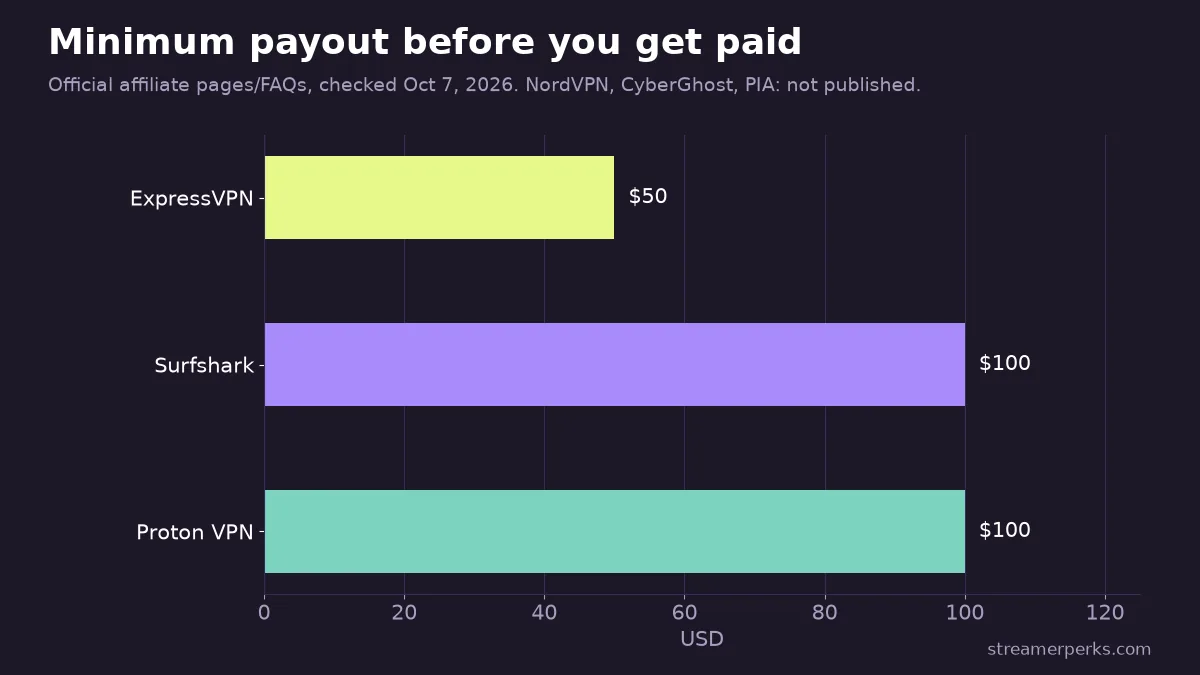
Payout thresholds matter for small channels, because a handful of sales a month can sit unpaid for a while.
ExpressVPN has the lowest published threshold at $50. It pays monthly on a Net 30 basis, so money arrives about 30 days after the month closes, minus refunds. PayPal works for any amount, and wire transfer is available above $1,000 a month.
Proton pays by bank transfer on the 30th of the following month once your balance passes $100. Smaller balances roll over.
Surfshark has a $100 minimum and pays within 30 days after a purchase clears. Regular earners can invoice monthly.
NordVPN, CyberGhost and PIA do not publish thresholds on their affiliate landing pages. You see them in the dashboard after signing up.
Keep refunds in mind as well. VPN brands offer money-back guarantees (CyberGhost advertises 45 days on its affiliate page), and refunded sales come off your commission.
Which VPN program should a streamer start with?
Pick based on the content you already make, not the headline rate.
- Small or mid-size channel, mostly live: NordVPN or Proton VPN. Renewals keep paying, both publish full rate tables, and neither requires a website.
- Privacy-minded audience: Proton VPN. Its 30% rate also covers Proton Mail, Pass and Drive renewals, so one partnership covers several products you might mention anyway.
- Budget or family audience with lots of devices: Surfshark, with its flat 40% and 30-day cookie.
- Large YouTube channel with steady video traffic: apply to ExpressVPN and ask for the CPA up front, then compare it with two years of a 40% + 30% program.
- CyberGhost and PIA: fine as secondary links, but their pages publish only "up to" figures, so you sign up without knowing your rate.
Promoting two programs is fine if you say so. Tag each placement with a sub-ID (panel, chat command, video description) and after a month check which one earns more per click. Our guide to turning short-form clips into affiliate sales covers tracking across platforms.
How I checked
On October 7, 2026, I read the official affiliate pages for NordVPN, Proton, Surfshark, ExpressVPN (landing page, FAQ and terms), CyberGhost and PIA. I also read Twitch's Branded Content Guidelines, YouTube's paid product placement help page, the FTC's influencer disclosure guide and Netflix's Terms of Use. I did not join these programs for this article, so in-dashboard terms (CPA amounts, unpublished cookie windows and thresholds) are marked as not published rather than estimated. These terms change often, so check the linked pages before you sign anything.
Related guides
- The Comprehensive 2026 VTuber Setup Guide: Best Trackers, Software, and Commissions
- The Best Audio Mixers and XLR Interfaces for Streamers in 2026
- The Ultimate Comparison of Custom Merch Platforms for Streamers in 2026
- Streamer Taxes 2026: LLC, Write-Offs and IRS Forms
- Best Streaming Software Compared (2026): OBS vs StreamElements vs Streamlabs vs XSplit