How to Negotiate Brand Deals as a Streamer (2026): Pricing, Contracts & Red Flags
StreamerPerks earns a commission from some outbound links. How programs are checked and how the site is funded.
Your first brand deal feels great right up until you find out you undercharged by 10x or signed away rights you didn't know you had.
Brand deals are one of the best-paying income sources for streamers in 2026, and they often earn more than subscriptions and donations combined. If you can't negotiate, though, you'll leave thousands of dollars on the table, or end up stuck in a contract that exploits you.
This guide covers how to price sponsorships (formulas and benchmarks), what to negotiate besides money, red flags in brand contracts, and templates and scripts for outreach and counter-offers.
Brand deal types
Sponsorships come in four main shapes, and they pay very differently.
1. Affiliate partnerships
- What it is: you promote a product and earn commission on sales
- Payment: performance-based (5-30% per sale)
- Commitment: low (you decide when and how you promote)
- Best for: testing products before you commit to paid deals
Example: promoting a gaming chair through your Amazon affiliate link.
2. Paid sponsorships (one-time)
- What it is: a brand pays you a flat fee to mention their product X times
- Payment: $100-$50,000+ depending on reach
- Commitment: fixed deliverables (e.g., "3 sponsored streams + 1 Instagram post")
- Best for: growing streamers building their rate card
Example: a VPN company pays you $500 to mention them in 3 streams.
3. Long-term partnerships
- What it is: an ongoing sponsorship (3-12 months) with recurring deliverables
- Payment: monthly retainer ($500-$100,000+)
- Commitment: high (exclusivity clauses, regular content)
- Best for: established streamers with consistent audiences
Example: an energy drink brand pays you $2,000/month to wear their logo and mention them twice a week.
4. Product seeding (free gear)
- What it is: brands send you free products and hope you'll promote them
- Payment: none (you keep the product)
- Commitment: none, though there's an implied expectation
- Best for: micro-streamers building relationships
Don't feel obligated to promote every free product that shows up. Your credibility is worth more than the gear.
How much should you charge for a sponsorship?
The industry formula (2026)
Cost per mille (CPM) method:
> Base Rate = (Average Concurrent Viewers × CPM Rate × Stream Duration in Hours)
CPM benchmarks by platform:
- Twitch: $15-$30 per 1,000 CCVs
- YouTube Live: $20-$40 per 1,000 CCVs
- Kick: $10-$25 per 1,000 CCVs (newer platform, rates still settling)
Example: you average 200 concurrent viewers on Twitch, stream for 3 hours, and use a $20 CPM:
> 200 CCVs × ($20 / 1,000) × 3 hours = $12 per stream
For a 3-stream sponsorship, that's a $36 base rate.
The engagement multiplier
If your chat is very active, multiply the base rate by 1.5-3x:
- 1.5x: average engagement (10-20% chat participation rate)
- 2x: high engagement (20-40% chat participation)
- 3x: cult following (40%+ chat participation and a dedicated Discord community)
With high engagement, that $36 sponsorship becomes a $54-$108 pitch.
Pricing by follower/subscriber count
This method works better for content that isn't live:
| Audience Size | Per Sponsored Stream | Per Social Post |
|---|---|---|
| 1K-5K followers | $100-$300 | $50-$150 |
| 5K-10K followers | $300-$750 | $150-$400 |
| 10K-50K followers | $750-$3,000 | $400-$1,500 |
| 50K-100K followers | $3,000-$10,000 | $1,500-$5,000 |
| 100K-500K followers | $10,000-$50,000 | $5,000-$20,000 |
| 500K+ followers | $50,000+ | $20,000+ |
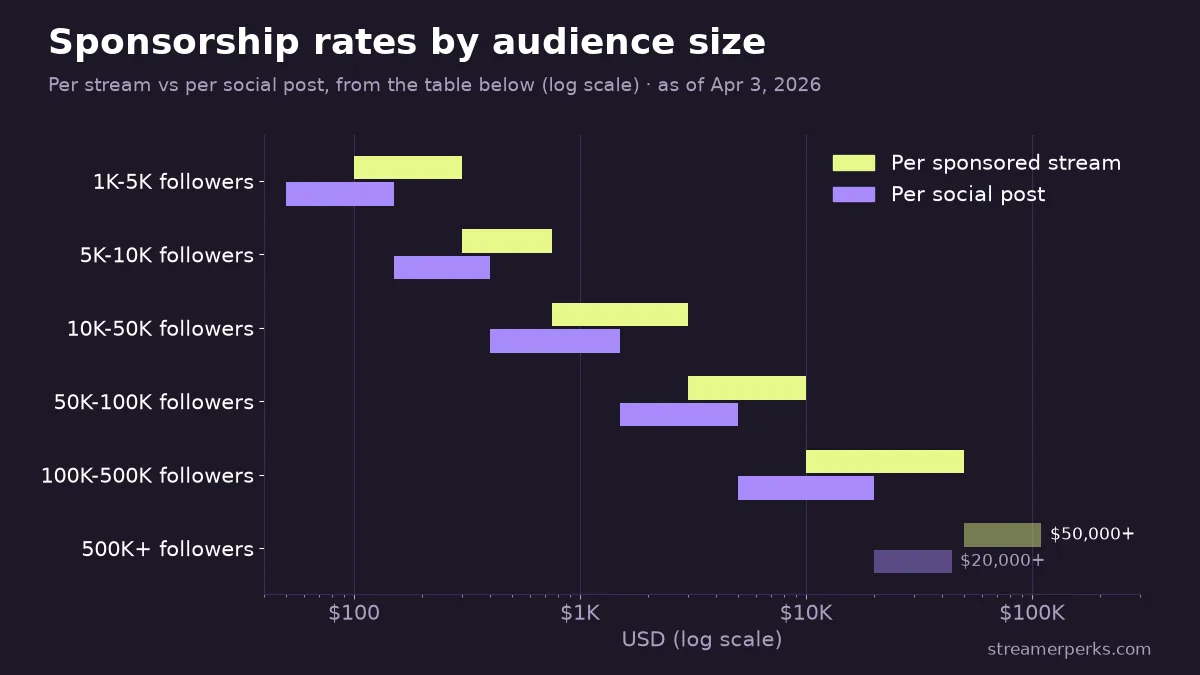
Treat these as starting points. Niche audiences (cybersecurity, finance and so on) can command 2-5x more than general gaming.
What should you negotiate besides the fee?
1. Usage rights
What it means: whether the brand can reuse your content in their ads.
Why it matters: your face in their marketing is extra value they should pay for.
What to ask for: +50% on the fee if they want your clips in paid ads.
Red flag: "We own all content created during the campaign."
Counter: "I retain rights. You can use clips for 90 days with proper credit."
2. Exclusivity clauses
What it means: you can't promote competing brands.
Why it matters: it limits what you can earn later.
What to ask for: a narrow category ("only energy drinks," not "all beverages"), extra pay for exclusivity (a 25-50% premium), and a time limit (30-90 days, never lifetime).
Red flag: "You cannot promote any competing product indefinitely."
Counter: "I'll agree to 90-day exclusivity for gaming peripherals specifically, with a 40% rate increase."
3. Creative freedom
What it means: whether you write your own ad read or have to use theirs.
Why it matters: promotion in your own words performs better and keeps your audience's trust.
What to ask for: "I'll include your main messaging, but in my own voice."
Red flag: "You must read this script word-for-word."
Counter: "I'm happy to hit these talking points, but my audience responds better when it's worked in naturally."
4. Payment terms
What it means: when and how you get paid.
Why it matters: some brands hold payment for 90+ days or want performance metrics first.
What to ask for: 50% upfront and 50% on delivery (not "Net 60 days"), a clear deliverable checklist, and payment by PayPal, Wise or direct deposit. Avoid checks.
Red flag: "Payment after we review performance metrics."
Counter: "I'll agree to performance bonuses, but the base fee is guaranteed regardless of sales."
5. Deliverable scope creep
What it means: brands asking for "just one more thing" after you've signed.
Why it matters: your time costs money.
What to ask for: a detailed scope in the contract, with nothing vague like "social media mentions."
Example of a tight scope: "Campaign includes: (3) 5-minute sponsored segments during live streams, (1) 60-second Instagram Reel, and (1) tweet. Additional deliverables require renegotiation."
What are the red flags in a brand contract?
"Payment is based on sales/conversions only"
Why it's bad: you do the work, and if it doesn't convert they got free marketing.
What to do: insist on a base fee plus a performance bonus.
"We require exclusive access to your analytics"
Why it's bad: they're mining your audience data without paying for it.
What to do: share high-level stats (total views, avg CCVs), not access to your dashboard.
"Contract is non-negotiable"
Why it's bad: almost everything is negotiable. This is a power play.
What to do: mark up the contract with your changes and send it back. Most brands will meet you partway.
"You must purchase product inventory to promote"
Why it's bad: that's a pyramid scheme / MLM warning sign.
What to do: walk away. Legitimate brands send free product or pay you to promote the stock they already have.
"We'll pay you in product/exposure"
Why it's bad: you can't pay rent with free t-shirts.
What to do: only accept this if you're under 1,000 followers and building relationships, the product is worth $500+, and you have a written agreement for future paid deals.
Sample scripts & templates
Outreach email (cold pitch)
> Subject: Partnership Opportunity with [Your Channel Name]
>
> Hi [Brand Contact Name],
>
> I'm [Your Name], a [Platform] streamer focused on [your niche: FPS games, cozy gaming, tech reviews].
>
> I have [X followers] and average [Y concurrent viewers], with an active community interested in [gaming gear, productivity tools, etc.].
>
> I'd love to talk about a partnership with [Brand Name]. I can offer sponsored stream segments, social media posts, and dedicated review content or setup tours.
>
> My audience trusts my recommendations, and I only partner with brands I actually use. Would you be open to a quick call?
>
> Best, [Your Name]
Rate card (one-pager)
Make a simple PDF with your stats:
| Package | Deliverables | Price |
|---|---|---|
| Single Stream Mention | 1 sponsored segment (5-10 min) | $XXX |
| Multi-Stream Campaign | 3 streams + 1 social post | $XXX |
| Full Integration Package | 5 streams + 3 social posts + dedicated video | $XXX |
Counter-offer email
> Hi [Brand Contact],
>
> Thanks for the offer. I'd like to work with [Brand Name].
>
> After reviewing the contract, I have a few changes to propose:
>
> 1. Rate: based on my engagement metrics and comparable creators, I'd like to propose [higher rate] instead. I can share detailed analytics to back this up.
> 2. Exclusivity: I'd prefer to narrow the exclusivity clause to [specific product category] for [60/90 days] rather than [broad category indefinitely].
> 3. Usage rights: you're welcome to share clips on your social media, but I'd like to keep ownership and add a fee if the content is used in paid advertising.
> 4. Payment terms: could we do 50% upfront and 50% on delivery, rather than Net 60?
>
> Let me know if these changes work for you. I think we can make this a good campaign for both sides.
How to get more bargaining power
1. Grow your media kit
Include viewer demographics (age, location, interests), engagement rates (chat activity, clip shares, Discord participation), results from past sponsorships, and testimonials from previous brand partners.
Tools for building a media kit: Canva (free templates), AspireIQ (influencer platform), CreatorHero (analytics for streamers).
2. Diversify your platforms
Brands pay more for reach across several platforms. A streamer with 10K Twitch followers, 5K YouTube subs and 15K TikTok followers can charge 2-3x more than someone who's only on Twitch.
3. Join creator networks
Platforms that connect streamers with brands:
- Gank: gaming-focused sponsorships
- Stream Connect
- Matchmade: brand deals for gamers
- PowerSpike
These platforms handle negotiation and contracts for a 10-20% cut. You give up some money and get a lot of time back.
4. Track everything
Use UTM codes, custom discount codes or dedicated landing pages to prove ROI. Brands pay more when you can show hard results. Tools: Bitly (link tracking), Google Analytics, and your affiliate dashboard.
When should you turn down a brand deal?
Even if the money is good, walk away if:
- The product is a scam (crypto pump-and-dump, a gambling site targeting minors)
- The brand has a history of not paying creators (search Reddit for complaints)
- The contract demands unreasonable rights (lifetime exclusivity, ownership of your channel)
- You don't believe in the product (your audience will notice)
Your reputation is what brands are paying for. One bad sponsorship can cost you more in lost credibility than the check was worth.
Final thoughts
Most streamers undercharge because they don't know the market rate, or because they feel lucky to get any offer at all.
Brands need creators. They come to you because your audience trusts you more than it trusts traditional ads, and that trust has a price. Don't sell it cheap.
Before you accept your next brand deal, find out what similar creators charge, work out your rate with the formulas above, negotiate at least 3 contract terms (rate, exclusivity, usage rights), get everything in writing, and track performance so you can justify a higher rate next time.
The gap between a $500 deal and a $5,000 deal is often just knowing what to ask for.
Related articles
Related guides
- Discord Monetization for Streamers: Memberships, Affiliate Links & Sponsor Deals (2026)
- How Much Do Streamers Make? Rates for Every Revenue Stream (2026)
- TikTok LIVE Gifts Explained: Coins, Diamonds and Creator Earnings
- Twitch Affiliate Requirements (2026): How to Become a Twitch Affiliate
- Twitch Bits to USD: What 1 Bit Is Worth and How Much Streamers Earn