Facebook vs YouTube Earnings (2026): Which Pays More, Which Is Easier, and How Creators Should Choose
StreamerPerks earns a commission from some outbound links. How programs are checked and how the site is funded.
If you searched "facebook vs youtube earnings comparison 2026", you're probably deciding where to spend your time.
Creators usually ask:
- Which platform pays more per view?
- Which one is easier to monetize?
- Which one is better for long-term income?
The honest answer: it depends on how your audience discovers you.
YouTube works more like a search engine, and videos stay findable for a long time. Facebook works more like a feed, with fast distribution and a short lifespan. That difference drives almost everything about what you earn.
Quick answer
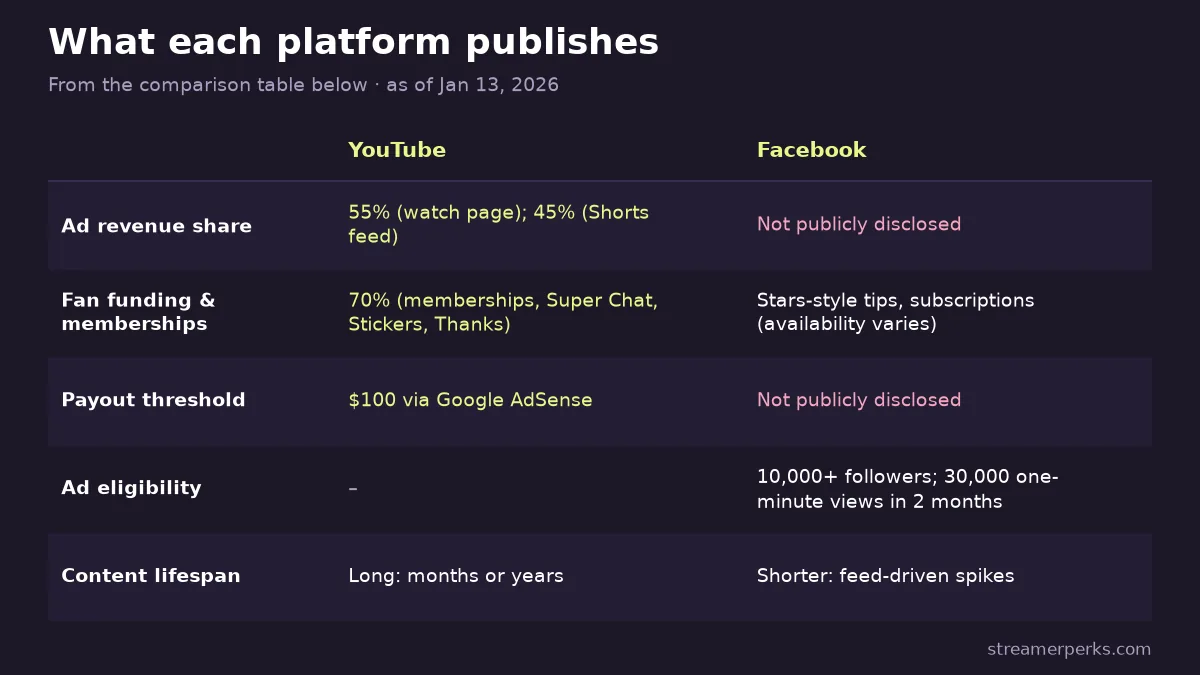
Know this before you compare the two: YouTube publishes its exact revenue-share percentages. Meta does not publish a revenue-share percentage for Facebook in-stream ads anywhere in its official documentation. So you can model YouTube earnings from public figures, but you can't model Facebook in-stream ad earnings from public information alone.
- For long-term earnings that build up from evergreen content, YouTube often wins.
- If you can make very shareable, feed-native content that spreads fast, Facebook can be strong.
- Many creators do best with both: YouTube as the "library" and Facebook for distribution.
Facebook vs YouTube at a glance
| YouTube | ||
|---|---|---|
| Revenue share | 55% of net revenues (watch-page ads); 45% of Shorts feed allocation; 70% (channel memberships, Super Chat, Super Stickers, Super Thanks). Source | Not publicly disclosed. Meta publishes in-stream ad eligibility thresholds but no revenue-share percentage in its official documentation |
| Payout threshold | $100 via Google AdSense | Not publicly disclosed |
| Monetization tools | Ads, memberships, live fan funding, shopping/affiliate, sponsorships | In-stream ads, Stars-style tipping, subscriptions (availability varies) |
| Discovery model | Search intent + suggested videos (evergreen) | Algorithmic feed + shares + community graph (spike-driven) |
| Content lifespan | Long: earns for months or years | Shorter: feed-driven spikes with faster drop-off |
| Long-term earning potential | Often higher (per creator comparisons) | Strong for highly shareable, high-volume content |
The biggest difference: intent vs feed
YouTube: search + suggested
People usually find YouTube videos through:
- search intent ("how to...", "best...", "review...")
- suggested videos based on watch history
That's why YouTube is good for evergreen earnings.
Facebook: feed + shares
People usually find Facebook videos through:
- algorithmic feed distribution
- shares and reposts
- community and interest graphs
You can get big spikes, but the content may not last as long.
Monetization ecosystems
YouTube monetization
YouTube gives you several income layers:
- ads (where eligible)
- memberships
- live fan funding
- shopping/affiliate
- sponsorships
Its main advantage is how well it rewards evergreen content.
Facebook monetization
Facebook monetization mostly comes from:
- in-stream ads (where eligible)
- Stars-style tipping (where available)
- subscriptions (where available)
In-stream ad eligibility (from Meta's official creators documentation): 10,000 or more Facebook followers; 3-minute videos that have generated more than 30,000 one-minute views in total over the past two months; and compliance with Meta's Partner Monetization Policies.
Revenue share: Meta does not publish a revenue-share percentage for Facebook in-stream ads anywhere in its official documentation. YouTube publishes exact splits, so you can forecast YouTube ad earnings. You can't do the same for Facebook in-stream ads from public information. Some competitor pages quote specific Facebook percentages, but none of those numbers come from Meta's own documentation.
Facebook's strength is distribution. How much you make often comes down to whether the algorithm picks you up.
Which pays more in 2026?
The honest version: YouTube publishes its splits (55% for watch-page ads, 70% for memberships and fan funding), so you can compare using verified figures. Meta does not publish a Facebook in-stream ad revenue-share percentage in its official documentation, which means any "Facebook pays X%" figure you see elsewhere is unverified. We'd rather tell you that plainly than repeat a number nobody can source.
In a lot of creator discussions, YouTube comes out ahead on overall earning potential because of:
- higher advertiser intent
- steadier long-term traffic
- more ways to monetize
Facebook can still beat YouTube for creators who:
- make very viral, shareable content
- have a community that shares a lot
- publish at high volume
A practical choice framework
Choose YouTube if:
- you make tutorials, reviews, or long-form commentary
- you want content that keeps earning for months or years
- you can build a library in one niche
Choose Facebook if:
- you can make feed content people want to share
- you're good at short, punchy videos
- your audience already spends its time on Facebook
Do both if:
- you can repurpose content (clips, short edits)
- you want to spread your platform risk
A hybrid strategy that works in 2026
A simple version:
- Make a strong "pillar" video for YouTube.
- Cut 5-10 clips from it.
- Upload the clips natively to Facebook.
- Use Facebook's reach to get your name out.
- Pull the most committed viewers over to your YouTube channel.
That's how Facebook spikes turn into long-term value.
Don't forget: creator earnings are not only platform payouts
Many of the highest-earning creators don't depend on platform payouts.
They stack:
- affiliate links
- sponsorships
- digital products
Extended FAQs
Does YouTube generally pay more than Facebook?
Many comparisons suggest YouTube offers more long-term earning potential, especially for evergreen content. Results still vary by niche, country, and which monetization features you have access to.
Is Facebook easier to get views on?
It can be, because feed distribution spikes quickly. Those spikes aren't consistent, though.
Which is better for livestreaming?
It depends on your audience. Some creators prefer YouTube for search discovery and the value of the archive. Others prefer Facebook for social sharing.
Which is better for beginner creators?
YouTube is often slower at first, but growth builds on itself. Facebook can spike faster and is less predictable. Beginners should pick the platform that fits their content.
Should I cross-post the same video?
Repurposing can work, but edits made for each platform usually do better.
How do I track which platform makes me more money?
Use UTMs, track affiliate link clicks and watch time, and compare your monthly net on each platform.
What's the safest approach?
Diversify. Build a YouTube library and use Facebook for distribution.
Related guides
- How Much Do Streamers Make? Rates for Every Revenue Stream (2026)
- YouTube Live Monetization (2026): All Revenue Streams, Requirements, and a Practical Creator Playbook
- YouTube Shopping Affiliate Program: Eligibility, Commissions and Live Tagging (2026)
- The Ultimate Comparison of Custom Merch Platforms for Streamers in 2026
- How to Get Verified on Twitch, YouTube & Kick (2026): Requirements & Strategies